Client production planning / Buyer planning guide
How agencies can brief a camera crew for a Las Vegas shoot
Give a local crew the assignment, access plan and technical handoff before the shoot. A practical briefing checklist for agency producers, with a fictional example.
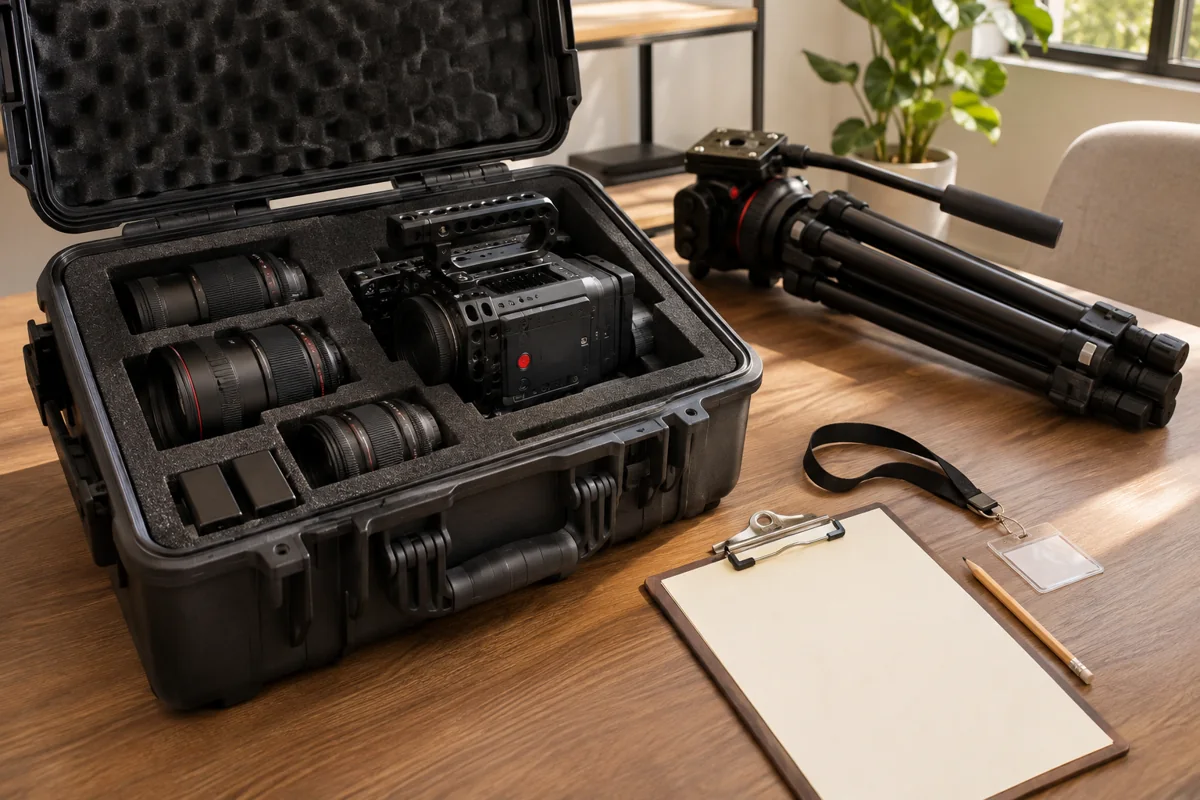
If your agency is bringing a project to Las Vegas, a useful camera-crew inquiry starts with the work that must happen on the day. A date and a camera model are a beginning. The crew also needs to understand who is directing, what must be recorded, how the location works and where the footage goes afterward.
This guide is for producers comparing options or preparing a handoff to a local crew. It focuses on the capture assignment rather than the later edit review. Use it to request a clearly scoped proposal and build a practical shoot brief. The checklist and example are recommendations, not a fixed RackFocus Cinema package or a promise of availability.
Explain the assignment before specifying the package
Describe the production in a few plain sentences: the client category, intended audience, subject matter, filming date, location status and required coverage. Say whether you need an interview, event coverage, a demonstration, supporting footage or a combination. Share the planned deliverables even if your agency will handle all post-production.
Then define the working arrangement. Will your producer or director be on site? Is someone directing remotely? Do you need a camera operator to execute an established plan, or help developing lighting and coverage? Identify who supplies sound recording, lighting support, production coordination and media management. Agree the actual responsibilities instead of assuming that “camera crew” includes every role.
Ask for the proposal to distinguish crew, equipment, planned working time, preparation and the media handoff. If a detail is undecided, label it as open. A request for options is more useful than a guessed equipment list presented as a final requirement.
Send a prioritized coverage brief
Give the crew an ordered list of what the edit needs. Separate essential moments from useful additions. Name any one-time action that cannot be repeated, and explain where it falls in the schedule. If two essential moments happen in different rooms at the same time, raise that conflict before confirming the coverage plan.
For interviews, send the number of speakers, approximate interview windows, intended framing and whether an interviewer appears on camera. Explain the backdrop and any visual references. Ask about a quiet room and preparation time rather than assuming an available meeting room is ready for filming.
For supporting footage, describe the activity and its purpose. “Show the technician checking the finished item” gives the crew a clearer target than “get cinematic B-roll.” Include restrictions on confidential displays, customer information, logos or work areas. Ask the agency or client owner to confirm what is approved for capture.
The event video shot-list guide can help organize coverage. The crew brief should translate that creative plan into people, places and time on the actual day.
Confirm the location and access route
For a hotel, conference venue, office or exhibition space in Las Vegas, request the exact meeting point and an authorized on-site contact. Clarify which entrance the crew should use, where equipment can be unloaded and where it can be stored. Distinguish the public arrival address from the agreed equipment access route.
Ask the location contact to confirm filming permission, credentials, insurance documentation and any venue-specific restrictions that apply to this production. Do not assume your agency's event registration grants every kind of filming access. Requirements vary; obtain the current instructions directly from the responsible venue or organizer.
Put access, setup, filming, breaks, room changes, strike and handoff into the schedule as separate activities. If the room is available only shortly before the interview, disclose that constraint when scoping the crew. Mark any unconfirmed space or access window so it remains an active planning question.
Share only the contact details and production information the crew needs, using the agreed private handoff. Keep a public-facing creative reference separate from private arrival instructions or sensitive client material.
Get the recording specification from post-production
Ask the receiving editor to confirm the camera requirements before the shoot. Record the requested resolution, frame rate, codec or recording format, color space or camera profile, audio arrangement and any synchronization needs. Include intended landscape and portrait versions so framing can be discussed while there is still time to test it.
A camera name alone does not settle those choices. Send the exact settings that matter to the receiving workflow, or ask the crew and editor to agree them together. Where compatibility is uncertain, request a short camera-original sample and have the editor test it before the main production.
For example, Adobe documents that Premiere's color management depends on correctly identifying a clip's color space. It can read available metadata, but missing, incorrect or unreadable metadata may require manual identification. That supports a practical handoff decision: record the capture profile and intended color treatment explicitly, rather than relying on the editor to infer them.
For a venue audio feed, ask the sound contact to confirm the output, connector and signal level. Shure explains that mic and line levels differ and that a mismatch can produce weak or distorted audio. Have the recording team confirm the connection and test it. The panel-discussion audio guide covers a more complete recording plan.
A fictional agency crew brief
Imagine an agency arranging an interview and supporting footage at a client's temporary meeting space. This is an illustrative brief, not an actual client production, quoted scope or equipment recommendation.
| Brief item | Information to send | Decision still required |
|---|---|---|
| Assignment | One interview and approved work-process footage; agency handles the edit | Who directs on site, and who approves additional coverage? |
| Coverage | Priority interview, demonstration and establishing views; optional details listed separately | Can the demonstration be repeated for coverage? |
| Location | Exact room, authorized contact, access instructions and confirmed filming window | When can lighting and sound preparation begin? |
| Recording | Editor-confirmed camera settings, audio tracks and framing needs | Has the editor accepted a sample file? |
| Handoff | Named recipient, agreed storage or transfer method, required notes and deadline | Who verifies the copies before cards are released? |
The open questions are part of the brief's value. Assign each one to a person and resolve it before treating the plan as final. Keep a dated version so the crew can distinguish an approved change from an earlier idea.
Plan the footage handoff before wrap
Say whether you need camera originals, separate audio, proxies, reference images, camera reports or another defined set of materials. Confirm the folder and naming expectations without asking the crew to improvise a new file structure while packing the room. Agree who supplies the receiving storage and whether any upload must finish on location.
A same-day handoff needs a real place in the schedule. Identify who makes the copies, who checks them and who signs off on receipt. Discuss the backup and retention arrangement separately from simply handing over a drive. The camera-footage backup guide explains why copy verification and card-release decisions deserve an explicit owner.
Ask for notes on changed camera settings, room changes, interruptions and known recording issues. These notes help your editor understand the material. If the shoot involves LED lighting or visible screens, include time for the pre-shoot flicker check rather than discovering the issue during the edit.
Confirm the people who can make decisions
Name the agency producer, client contact, on-site director, location contact and media recipient as applicable. Identify who can approve a schedule change, new setup or additional coverage. A crew should have a clear route for resolving conflicting instructions without having to guess which stakeholder has the final say.
Before the shoot, hold a short production call around the remaining uncertainties. Review the priority coverage, access route, setup time, technical specification and handoff. Confirm how urgent changes will reach the crew on the day. Send a final brief and call information through the agreed channel, and mark what supersedes earlier versions.
After capture, the edit-approval brief can carry the project into post-production. Keeping the capture responsibilities clear first gives that later review a more useful starting point.
What to include in your first inquiry
Start with the filming date, Las Vegas location or venue status, a short description of the assignment, priority coverage, agency-provided roles and intended footage handoff. Add your known technical requirements and the most important open questions. You do not need to pretend every detail is settled to begin a useful conversation.
Contact RackFocus Cinema to discuss the crew brief. Share the purpose and constraints so the conversation can establish scope, responsibilities and the next planning step.
Sources and planning limits
Primary sources inspected November 2, 2026. The buyer checklist and fictional example are editorial recommendations. Venue access and permissions must be confirmed for the actual production; this article states no venue-specific rule, rate, availability or guaranteed result.
- Adobe: Configure clips for Color Management using Clip Modify — supports the limited statement about correct source color-space identification and metadata limitations. The receiving editor should confirm the actual workflow.
- Shure: Tell Me About Mic and Line Level — supports the distinction between signal levels and mismatched-input consequences. Equipment and routing should be tested by the recording team.